Posts tonen met het label kerkgeschiedenis algemeen. Alle posts tonen
Posts tonen met het label kerkgeschiedenis algemeen. Alle posts tonen
zaterdag 9 november 2024
vrijdag 12 november 2021
John Henry Newman 1801-1890 The Church of the Fathers – 9. Conversion of Augustine

Chapter 9. Conversion of Augustine
2.
But let us
consider what his misery was;—it was that of a mind imprisoned, solitary, and
wild with spiritual thirst; and forced to betake itself to the strongest
excitements, by way of relieving itself of the rush and violence of feelings,
of which the knowledge of the Divine Perfections was the true and sole
sustenance. He ran into excess, not from love of it, but from this fierce fever
of mind. "I sought what I might love," he says in his Confessions,
"in love with loving, and safety I hated, and a way without snares. For
within me was a famine of that inward food, Thyself, my God; yet throughout
that famine I was not hungered, but was without any longing for incorruptible
sustenance, not because filled therewith, but the more empty, the more I
loathed it. For this cause my soul was sickly and full of sores; it miserably
cast itself forth, desiring to be scraped by the touch of objects of
sense."—iii. 1.
"O
foolish man that I then was," he says elsewhere, "enduring
impatiently the lot of man! So I fretted, sighed, wept, was distracted; had
neither rest nor counsel. For I bore about a shattered and bleeding soul, impatient
of being borne by me, yet where to repose it I found not; not in calm groves,
nor in games and music, nor in fragrant spots, nor in curious banquetings, nor
in indulgence of the bed and the couch, nor, finally, in books or poetry found
it repose. All things looked ghastly, yea, the very light. In groaning and
tears alone found I a little refreshment. But when my soul was withdrawn from
them, a huge load of misery weighed me down. To Thee, O Lord, it ought to have
been raised, for Thee to lighten; I knew it, but neither could nor would; the
more, since when I thought of Thee, Thou wast not to me any solid or
substantial thing. For Thou wert not Thyself, but a mere phantom, and my error
was my God. If I offered to discharge my load thereon, that it might rest, it
glided through the void, and came rushing down against me; and I had remained
to myself a hapless spot, where I could neither be, nor be from thence. For
whither should my heart flee from my heart? whither should I flee from myself?
whither not follow myself? And yet I fled out of my country; for so should mine
eyes look less for him, where
they were not wont to see him."— iv. 12.
He is
speaking in this last sentence of a friend he had lost, whose death-bed was
very remarkable, and whose dear familiar name he apparently has not courage to
mention. "He had grown up from a child with me," he says, "and
we had been both schoolfellows and play-fellows." Augustine had misled him
into the heresy which he had adopted himself, and when he grew to have more and
more sympathy in Augustine's pursuits, the latter united himself to him in a
closer intimacy. Scarcely had he thus given him his heart, when God took him.
The
Manichees, it should be observed, rejected baptism. He proceeds: "But it
proved far otherwise; for he was refreshed and restored. Forthwith, as soon as
I could speak with him (and I could as soon as he was able, for I never left
him, and we hung but too much upon each other), I essayed to jest with him, as
though he would jest with me at that baptism, which he had received, when
utterly absent in mind and feeling, but had now understood that he had
received. But he shrunk from me, as from an enemy; and with a wonderful and
sudden freedom bade me, if I would continue his friend, forbear such language
to him. I, all astonished and amazed, suppressed all my emotions till he should
grow well, and his health were strong enough for me to deal with him as I
would. But he was taken away from my madness, that with Thee he might be
preserved for my comfort: a few days after, in my absence, he was attacked
again by fever, and so departed."
3.
From
distress of mind Augustine left his native place, Thagaste, and came to
Carthage, where he became a teacher in rhetoric. Here he fell in with Faustus,
an eminent Manichean bishop and disputant, in whom, however, he was
disappointed; and the disappointment abated his attachment to his sect, and
disposed him to look for truth elsewhere. Disgusted with the licence which
prevailed among the students at Carthage, he determined to proceed to Rome, and
disregarding and eluding the entreaties of his mother, Monica, who dreaded his
removal from his own country, he went thither. At Rome he resumed his
profession; but inconveniences as great, though of another kind, encountered
him in that city; and upon the people of Milan sending for a rhetoric reader,
he made application for the appointment, and obtained it. To Milan then he
came, the city of St. Ambrose, in the year of our Lord 385.
Ambrose,
though weak in voice, had the reputation of eloquence; and Augustine, who seems
to have gone with introductions to him, and was won by his kindness of manner,
attended his sermons with curiosity and {148} interest. "I listened,"
he says, "not in the frame of mind which became me, but in order to see
whether his eloquence answered what was reported of it: I hung on his words
attentively, but of the matter I was but an unconcerned and contemptuous
hearer."—v. 23. His impression of his style of preaching is worth
noticing: "I was delighted with the sweetness of his discourse, more full
of knowledge, yet in manner less pleasurable and soothing, than that of
Faustus." Augustine was insensibly moved: he determined on leaving the
Manichees, and returning to the state of a catechumen in the Catholic Church,
into which he had been admitted by his parents. He began to eye and muse upon
the great bishop of Milan more and more, and tried in vain to penetrate his
secret heart, and to ascertain the thoughts and feelings which swayed him. He
felt he did not understand him. If the respect and intimacy of the great could
make a man happy, these advantages he perceived Ambrose to possess; yet he was
not satisfied that he was a happy man. His celibacy seemed a drawback: what
constituted his hidden life? or was he cold at heart? or was he of a famished
and restless spirit? He felt his own malady, and longed to ask him some
questions about it. But Ambrose could not easily be spoken with. Though
accessible to all, yet that very circumstance made it difficult for an
individual, especially one who was not of his flock, to get a private interview
with him. When he was not taken up with the Christian people who surrounded
him, he was either at his meals or engaged in private reading. Augustine used
to enter, as all persons might, without being announced; but after staying
awhile, afraid of interrupting him, he departed again. However, he heard his
expositions of Scripture every Sunday, and gradually made progress.
 He was now
in his thirtieth year, and since he was a youth of eighteen had been searching
after truth; yet he was still "in the same mire, greedy of things
present," but finding nothing stable.
He was now
in his thirtieth year, and since he was a youth of eighteen had been searching
after truth; yet he was still "in the same mire, greedy of things
present," but finding nothing stable.

"Tomorrow,"
he said to himself, "I shall find it; it will appear manifestly, and I
shall grasp it: lo, Faustus the Manichee will come and clear every thing! O you
great men, ye academics, is it true, then, that no certainty can be attained
for the ordering of life? Nay, let us search diligently, and despair not. Lo,
things in the ecclesiastical books are not absurd to us now, which sometime
seemed absurd, and may be otherwise taken and in a good sense. I will take my
stand where, as a child, my parents placed me, until the clear truth be found
out. But where shall it be sought, or when? Ambrose has no leisure; we have no
leisure to read; where shall we find even the books? where, or when, procure
them? Let set times be appointed, and certain hours be ordered for the health
of our soul. Great hope has dawned; the Catholic faith teaches not what we
thought; and do we doubt to knock, that the rest may be opened? The forenoons,
indeed, our scholars take up; what do we during the rest of our time? why not
this? But if so, when pay we court to our great friend, whose favours we need?
when compose what we may sell to scholars? when refresh ourselves, unbending
our minds from this intenseness of care?
"Perish
every thing: dismiss we these empty vanities; and betake ourselves to the one
search for truth! Life is a poor thing, death is uncertain; if it surprises us,
in what state shall we depart hence? and when shall we learn what here we have
neglected? and shalt we not rather suffer the punishment of this negligence?
What if death itself cut off and end all care and feeling? Then must this be ascertained.
But God forbid this! It is no vain and empty thing, that the excellent dignity
of the Christian faith has overspread the whole world. Never would such and so
great things be wrought for us by God, if with the body the soul also came to
an end. Wherefore delay then to abandon worldly hopes, and give ourselves
wholly to seek after God and the blessed life? But wait: even those things are
pleasant; they have some and no small sweetness. We must not lightly abandon
them, for it were a shame to return again to them. See, how great a matter it
is now to obtain some station, and then what should we wish for more? We have
store of powerful friends; if nothing else offers, and we be in much haste, at
least a presidency may be given us; and a wife with some fortune, that she
increase not our charges; and this shall be the bound of desire. Many great
men, and most worthy of imitation, have given themselves to the study of wisdom
in the state of marriage."—vi. 18, 19.

dinsdag 9 november 2021
John Henry Newman 1801-1890 The Church of the Fathers - 6 Augustine and the Vandals
"The fury of the Vandals was especially exercised
towards the memorials of religion"


Capita selecta- Chapter 7.
Augustine and the Vandals
"The just perisheth, and no man layeth it to
heart; and men of mercy are taken away, for there is none to understand; for
the just man is taken away from before the face of evil."
I BEGAN by directing the reader's attention to the
labours of two great bishops, who restored the faith of Christianity where it
had long been obscured. Now, I will put before him, by way of contrast, a scene
of the overthrow of religion,—the extinction of a candlestick,—effected, too,
by champions of the same heretical creed which Basil and Gregory successfully
resisted. It will be found in the history of the last days of the great
Augustine, bishop of Hippo, in Africa. The truth triumphed in the East by the
power of preaching; it was extirpated in the South by the edge of the sword.
Though it may not be given us to appropriate the
prophecies of the Apocalypse to the real events to which they belong, yet it is
impossible to read its inspired pages, and then to turn to the dissolution of
the Roman empire, without seeing a remarkable agreement, on the whole, between
the calamities of that period and the sacred prediction. There is a plain
announcement in the inspired page, of "Woe, woe, woe, to the inhabitants
of the earth;" an announcement of "hail and fire mingled with
blood," the conflagration of "trees and green grass," the
destruction of ships, the darkening of the sun, and the poisoning of the rivers
over a third of their course. There is a clear prophecy of revolutions on the
face of the earth and in the structure of society. And, on the other hand, let
us observe how fully such general foretokenings are borne out, among other
passages of history, in the Vandalic conquest of Africa.
The coast of Africa, between the great desert and the
Mediterranean, was one of the most fruitful and opulent portions of the Roman
world. The eastern extremity of it was more especially connected with the
empire, containing in it Carthage, Hippo, and other towns, celebrated as being
sees of the Christian Church, as well as places of civil importance. In the
spring of the year 428, the Vandals, Arians by creed, and barbarians by birth
and disposition, crossed the Straits of Gibraltar, and proceeded along this
fertile district, bringing with them devastation and captivity on every side.
They abandoned themselves to the most savage cruelties and excesses. They
pillaged, ravaged, burned, massacred all that came in their way, sparing not
even the fruit-trees, which might have afforded some poor food to the remnant
of the population, who had escaped from them into caves, the recesses of the
mountains, or into vaults. Twice did this desolating pestilence sweep over the
face of the country.
The fury of the Vandals was especially exercised
towards the memorials of religion. Churches, cemeteries, monasteries, were
objects of their fiercest hatred and most violent assaults. They broke into the
places of worship, cut to pieces all internal decorations, and then set fire to
them. They tortured bishops and clergy with the hope of obtaining treasure. The
names of some of the victims of their ferocity are preserved. Mansuetus, bishop
of Utica, was burnt alive; Papinianus, bishop of Vite, was laid upon red-hot
plates of iron. This was near upon the time when the third General Council was
assembling at Ephesus, which, from the insecure state of the roads, and the
universal misery which reigned among them, the African bishops were prevented
from attending. The Clergy, the religious brotherhoods, the holy virgins, were
scattered all over the country. The daily sacrifice was stopped, the sacraments
could not be obtained, the festivals of the Church passed unnoticed. At length,
only three cities remained unvisited by the general desolation,—Carthage,
Hippo, and Cirtha.
2.
Hippo was the see of St. Austin, then seventy-four
years of age (forty almost of which had been passed in ministerial labours),
and warned, by the law of nature, of the approach of dissolution. It was as if
the light of prosperity and peace were fading away from the African Church, as
sank the bodily powers of its great earthly ornament and stay. At this time,
when the terrors of the barbaric invasion spread on all sides, a bishop wrote
to him to ask whether it was allowable for the ruler of a Church to leave the
scene of his pastoral duties in order to save his life. Different opinions had
heretofore been expressed on this question. In Augustine's own country
Tertullian had maintained that flight was unlawful, but he was a Montanist when
he so wrote. On the other hand, Cyprian had actually fled, and had defended his
conduct when questioned by the clergy of Rome. His contemporaries, Dionysius of
Alexandria, {130} and Gregory of Neocæsarea, had fled also; as had Polycarp
before them, and Athanasius after them.
Athanasius also had to defend his flight, and he
defended it, in a work still extant, thus:—First, he observes, it has the
sanction of numerous Scripture precedents. Thus, in the instance of confessors
under the old covenant, Jacob fled from Esau, Moses from Pharao, David from
Saul; Elias concealed himself from Achab three years, and the sons of the
prophets were hid by Abdias in a cave from Jezebel. In like manner under the
Gospel, the disciples hid themselves for fear of the Jews, and St. Paul was let
down in a basket over the wall at Damascus. On the other hand, no instance can
be adduced of over-boldness and headstrong daring in the saints of Scripture.
But our Lord Himself is the chief exemplar of fleeing from persecution. As a
child in arms He had to flee into Egypt. When He returned, He still shunned
Judea, and retired to Nazareth. After raising Lazarus, on the Jews seeking His
life, "He walked no more openly among them," but retreated to the
neighbourhood of the desert. When they took up stones to cast at Him, He hid
Himself; when they attempted to cast Him down headlong, He made His way through
them; when He heard of the Baptist's death, He retired across the lake into a
desert place, apart. If it be said that He did so, because His time was not yet
come, and that when it was come, He delivered up Himself, we must ask, in
reply, how a man can know that his time is come, so as to have a right to act
as Christ acted? And since we do not know, we must have patience; and, till God
by His own act determines the time, we must "wander in sheepskins and
goat-skins," rather than take the matter into our own hands; as even Saul,
the persecutor, was left by David in the hands of God, whether He would
"strike him, or his day should come to die, or he should go down to battle
and perish."
If God's servants, proceeds Athanasius, have at any
time presented themselves before their persecutors, it was at God's command:
thus Elias showed himself to Achab; so did the prophet from Juda, to Jeroboam;
and St. Paul appealed to Cæsar. Flight, so far from implying cowardice,
requires often greater courage than not to flee. It is a greater trial of
heart. Death is an end of all trouble; he who flees is ever expecting death,
and dies daily. Job's life was not to be touched by Satan, yet was not his
fortitude shown in what he suffered? Exile is full of miseries. The
after-conduct of the saints showed they had not fled for fear. Jacob, on his
deathbed, contemned death, and blessed each of the twelve Patriarchs; Moses
returned, and presented himself before Pharao; David was a valiant warrior;
Elias rebuked Achab and Ochazias; Peter and Paul, who had once hid themselves,
offered themselves to martyrdom at Rome. And so acceptable was the previous
flight of these men to Almighty God, that we read of His showing them some
special favour during it. Then it was that Jacob had the vision of Angels;
Moses saw the burning bush; David wrote his prophetic Psalms; Elias raised the
dead, and gathered the people on Mount Carmel. How would the Gospel ever have
been preached throughout the world, if the Apostles had not fled? And, since
their time, those, too, who have become martyrs, at first fled; or, if they
advanced to meet their persecutors, it was by some secret suggestion of the
Divine Spirit. But, above all, while these instances abundantly illustrate the
rule of duty in persecution, and the temper of mind necessary in those who
observe it, we have that duty itself declared in a plain precept by no other
than our Lord: "When they shall persecute you in this city," He says,
"flee into another;" and "let them that are in Judea flee unto
the mountains."
Thus argues the great Athanasius, living in spirit
with the saints departed, while full of labour and care here on earth. For the
arguments on the other side, let us turn to a writer, not less vigorous in
mind, but less subdued in temper. Thus writes Tertullian on the same subject,
then a Montanist, a century and a half earlier:—Nothing happens, he says,
without God's will. Persecution is sent by Him, to put His servants to the
test; to divide between good and bad: it is a trial; what man has any right to
interfere? He who gives the prize, alone can assign the combat. Persecution is
more than permitted, it is actually appointed by Almighty God. It does the
Church much good, as leading Christians to increased seriousness while it
lasts. It comes and goes at God's ordering. Satan could not touch Job, except
so far as God gave permission. He could not touch the Apostles, except as far
as an opening was allowed in the words, "Satan hath desired to have you,
but I have prayed for thee," Peter, "and thou, being once converted,
confirm thy brethren." We pray, "Lead us not into temptation, but
deliver us from evil;" why, if we may deliver ourselves? Satan is
permitted access to us, either for punishment, as in Saul's case, or for our
chastisement. Since the persecution comes from God, we may not lawfully avoid
it, nor can we avoid it. We cannot, because He is all powerful; we must not,
because He is all good. We should leave the matter entirely to God. As to the
command of fleeing from city to city, this was temporary. It was intended to
secure the preaching of the Gospel to the nations. While the Apostles preached
to the Jews,—till they had preached to the Gentiles,—they were to flee; but one
might as well argue, that we now are not to go "into the way of the
Gentiles," but to confine ourselves to "the lost sheep of the house
of Israel," as that we are now to "flee from city to city." Nor,
indeed, was going from city to city a flight; it was a continued preaching; not
an accident, but a rule: whether persecuted or not, they were to go about; and
before they had gone through the cities of Israel, the Lord was to come. The
command contemplated only those very cities. If St. Paul escaped out of
Damascus by night, yet afterwards, against the prayers of the disciples and the
prophecy of Agabus, he went up to Jerusalem. Thus the command to flee did not
last even through the lifetime of the Apostles; and, indeed, why should God
introduce persecution, if He bids us retire from it? This is imputing
inconsistency to His acts. If we want texts to justify our not fleeing, He
says, "Whoso shall confess Me before men, I will confess him before My
Father." "Blessed are they that suffer persecution;" "He
that shall persevere to the end, he shall be saved;" "Be not afraid
of them that kill the body;" "Whosoever does not carry his cross and
come after Me, cannot be My disciple." How are these texts fulfilled when
a man flees? Christ, who is our pattern, did not more than pray, "If it be
possible, let this chalice pass:" we, too, should both stay and pray as He
did. And it is expressly told us, that "We also ought to lay down our
lives for the brethren." Again, it is said, "Perfect charity casteth
out fear;" he who flees, fears; he who fears, "is not perfected in
charity." The Greek proverb is sometimes urged, "He who flees, will
fight another day;" yes, and he may flee another day, also. Again, if
bishops, priests, and deacons flee, why must the laity stay? or must they flee
also? "The good shepherd," on the contrary, "layeth down his
life for his sheep;" whereas, the bad shepherd "seeth the wolf
coming, and leaveth the sheep, and fleeth." At no time, as Jeremiah,
Ezekiel, and Zechariah tell us, is the flock in greater danger of being
scattered than when it loses its shepherd. Tertullian ends thus:—"This
doctrine, my brother, perhaps appears to you hard; nay, intolerable. But
recollect that God has said, 'He that can take, let him take it;' that is, he
who receives it not, let him depart. He who fears to suffer cannot belong to
Him who has suffered. He who does not fear to suffer is perfect in love, that
is, of God. Many are called, few are chosen. Not he who would walk the broad
way is sought out by God, but he who walks the narrow." Thus
the ingenious and vehement Tertullian.
vrijdag 20 november 2020
21 november Opdracht van Maria in de tempel van Jeruzalem Wij hernieuwen onze kloostergeloften

21 november
Gedachtenis
van de Opdracht van Maria in de tempel van Jeruzalem
Wij hernieuwen onze kloostergeloften
De gedachtenis van de Opdracht van
Maria in de tempel, “Maria Presentatie”, gaat volgens het Romeinse
Martyrologium terug tot de viering van de kerkwijding van de basiliek “Sancta
Maria Nova” die men bij de muur van de tempel had gebouwd. Op deze dag werd
tevens die toewijding gevierd waarmee de toekomstige Moeder van God
zichzelf al vanaf haar kinderjaren aan God heeft toegewijd, daartoe bewogen
door de Heilige Geest, die haar vanaf het moment van haar onbevlekte
ontvangenis met zijn genade heeft vervuld.
De meeste kanunnikessenkloosters van de
orde van het Heilig Graf kozen in de 17e eeuw een Mariafeest voor de
jaarlijkse vernieuwing van hun geloften, waarbij de keuze voor het feest van
Maria Presentatie als volledige toewijding van Maria aan God het eerst voor de
hand lag.
Het gaat niet om het aangaan van een
nieuwe verbintenis maar om een bevestiging én hernieuwing van de persoonlijke
toewijding aan God in de gave van hun leven als religieuze en aan de zending in
de Kerk volgens de eigen spiritualiteit.
De jaarlijkse Hernieuwing van de Geloften
is daarmee een sterke aanmoediging om de essentie van het kloosterleven ten
volle en bewust te beleven volgens de Handelingen van de Apostelen (vgl.
2,44-46 en 4,32-35 ): eensgezind volharden in het gebed, getuigen van de
realiteit van de Verrijzenis en apostolisch dienstbetoon.
Paus Pius XII bestemde reeds in 1953 21
november als de Dag “pro orantibus Dei” – voor de biddenden tot God -,
ook bekend als de dag voor complatieven in de slotkloosters. Paus
Johannes–Paulus II heeft deze viering later uitgebreid en de gelovigen
aangemoedigd deze specifieke roeping binnen het Volk van God op alle mogelijke
wijzen te ondersteunen. Deze dag geeft aan 21 november als dag van de
Hernieuwing van de Geloften voor ons, die een “vita mixta” leven – een
kloosterlijke levensvorm waarin beide accenten: contemplatief-actief en
actief-contemplatief tot hun recht komen
- een diepere dimensie.
Van 29 november 2014 tot en met 2
februari 2016 wordt het “Jaar van het godgewijde Leven” gevierd waarbij
dankbaarheid, nieuw elan, hoop en evangelisch engagement leidende principes
zijn.
Is het voor iedereen van fundamenteel
belang het gesprek met God dagelijks gaande te houden, voor de religieuzen,
eens door God zelf persoonlijk aangeraakt, is dat een consequentie vanuit hun
roeping. Zij stellen immers het voortdurende “quærere Deum” – het zoeken naar
God – voorop, met de gezindheid van Jezus Christus die het Gelaat van God
openbaart, wanneer zij hun blik op de onzichtbare Realiteit richten, die eeuwig
is en die de hoop van de menselijke voltooiing volledig in zich draagt.
Voortvloeiend uit deze gesteltenis staan zij open voor de medemens en laten het
Gelaat van Christus zien door hun leven, op het fundament van het Evangelie.
“Op
grond van de absolute voorrang die zij aan Christus geven, zijn de kloosters
geroepen plaatsen te zijn waar de heerlijkheid van God wordt gevierd, waar men
bidt en de verborgen en tegelijk concrete tegenwoordigheid van God in de wereld
bezingt, waar men probeert het nieuwe gebod van de liefde en het elkaar
dienen in praktijk te brengen” (Benedictus XVI, nov. 2008).
dinsdag 28 april 2020
"Heb medelijden, eeuwige God, met uw schapen!" - H. Catharina van Siena
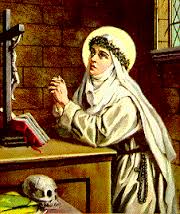
“Heb medelijden, eeuwige God, met uw schapen! U bent immers
de goede Herder. Aarzel niet barmhartig te zijn voor de wereld! Het ziet immers
zo uit alsof deze niet meer verder kan. Want de vereniging in liefde met U,
eeuwige Waarheid, en bij de mensen onderling lijkt volledig verloren te zijn gegaan.
De mensen beminnen elkaar niet met de liefde die in U haar wortels heeft.”
(Dialogo della
Divina Provvidenza, cap. 16)
zondag 19 mei 2019
dinsdag 12 september 2017
dinsdag 5 september 2017
Basilica di San Marco - Venezia
Basilica di San Marco overgenomen van Jan Reijmerink op youtube:
De huidige basiliek is de derde kerk op deze plaats. Hij dateert van rond 1060. De basiliek is gebouwd om de overblijfselen van de heilige Marcus, die in 828 door Venetië geroofd waren uit Alexandrië, een laatste rustplaats te bieden.
Het gebouw wordt gezien als een van de mooiste basilieken van Europa en heeft zowel een interessant exterieur en interieur.
De gevel van de basiliek is versierd met onder andere een vierspan en de Venetiaanse leeuw, symbool van Marcus de evangelist. Het bronzen vierspan op de gevel is een replica van de originele paardengroep, die waarschijnlijk uit de 2e eeuw stamt. Deze paarden zijn uniek omdat andere groepen van triomfkarpaarden uit de oudheid niet bewaard zijn gebleven. Ze zijn als buit van de Vierde Kruistocht uit Constantinopel naar Venetië gebracht. Napoleon heeft de paarden enige tijd op de Arc de Triomphe in Parijs laten plaatsen. De kerven in de paardengroep zijn met opzet aangebracht om schittering te voorkomen.
De basiliek heeft vijf koepels en is rijkelijk versierd en voorzien van bogen en vele torentjes. De hoofdingang heeft beeldhouwwerken uit de 13e eeuw die de maanden van het jaar uitbeelden. Boven de hoofdingang staan beelden uit de 15e eeuw van San Marco en diverse engelen. Naast de basiliek staat de Campanile.
Interieur
Het interieur is beroemd om zijn mozaïeken in de koepels en om de golvende vloeren van marmer en mozaïek. Het heeft de vorm van een Grieks kruis, en op alle uiteinden, en op het kruispunt zijn koepels aangebracht; de bekendste koepels zijn de Hemelvaartkoepel uit de 13e eeuw en de Pinksterkoepel uit de 12e eeuw. In het Atrium (vestibule) zijn ook mozaïeken uit 13e eeuw in de koepel. Het zijn twaalf episoden uit het Oude Testament in de Genesiskoepel tot afbeeldingen over Jozef en Mozes.
De sarcofaag van Sint Marcus staat achter het altaar.
Achter de kapel van de Heilige Clemens is het beroemde van edelstenen voorziene altaarstuk, de Pala d'Oro te zien. Hoewel Napoleon verschillende edelstenen geroofd heeft uit het altaarstuk is het nog redelijk intact. Het heeft 250 brandschilderwerken op goudfolie in een gouden lijst. Het is in 976 in Byzantium gemaakt en is ook roofbuit van de Vierde Kruistocht.
De iconostase (een scherm tussen het schip en het preekgestoelte) is versierd met marmeren beelden van Maria en de apostelen. Het is gemaakt door de broers Dallle Masegne in 1394. Er is een baldakijn boven het hoofdaltaar.
Er zijn diverse kapellen, zoals de doopkapel (Chiesa des putti wat "kerk van de baby's" betekent), de Zenkapel waar kardinaal Zen begraven ligt, de kapel van de Heilige Isidorus is alleen toegankelijk voor gebed en de Mascolikapel versierd met afbeeldingen van Maria. Verder nog de Mascolikapel, genoemd naar het broederschap Mascoli en de San Pietrokapel.
Bij de hoofdingang is ook de trap naar de eerste verdieping, de Loggia dei Cavalli. Dit is het Museum Marciano. Hier zijn onder andere de originele vergulde bronzen paarden (Quadriga) te zien. Bovendien zijn de mozaïeken hier van dichterbij te bekijken. Ook zijn er verschillende schaalmodellen te zien. Hier is ook nog de Pala feriale van Paolo Veneziano uit de 14e eeuw te zien.
In de rechterzijbeuk is de Schatkamer (Tresoro) van de San Marco. Hierin zijn andere schatten te zien die meegenomen werden als buit van de Vierde Kruistocht, met nog een verzameling Byzantijns zilver, goud en glaswerk. Er zijn bokalen, reliekhouders, kelken en twee iconen van de aartsengel Michael. Ook is er nog een reliekhouder met de vorm van een basiliek met vijf koepels uit de 11e eeuw.
Ook zijn hier verschillende relieken te zien met botten van onder andere Sint Marcus en Jakobus de Mindere.
Abonneren op:
Posts (Atom)