Posts tonen met het label OLV Rozenkrans. Alle posts tonen

donderdag 7 oktober 2021

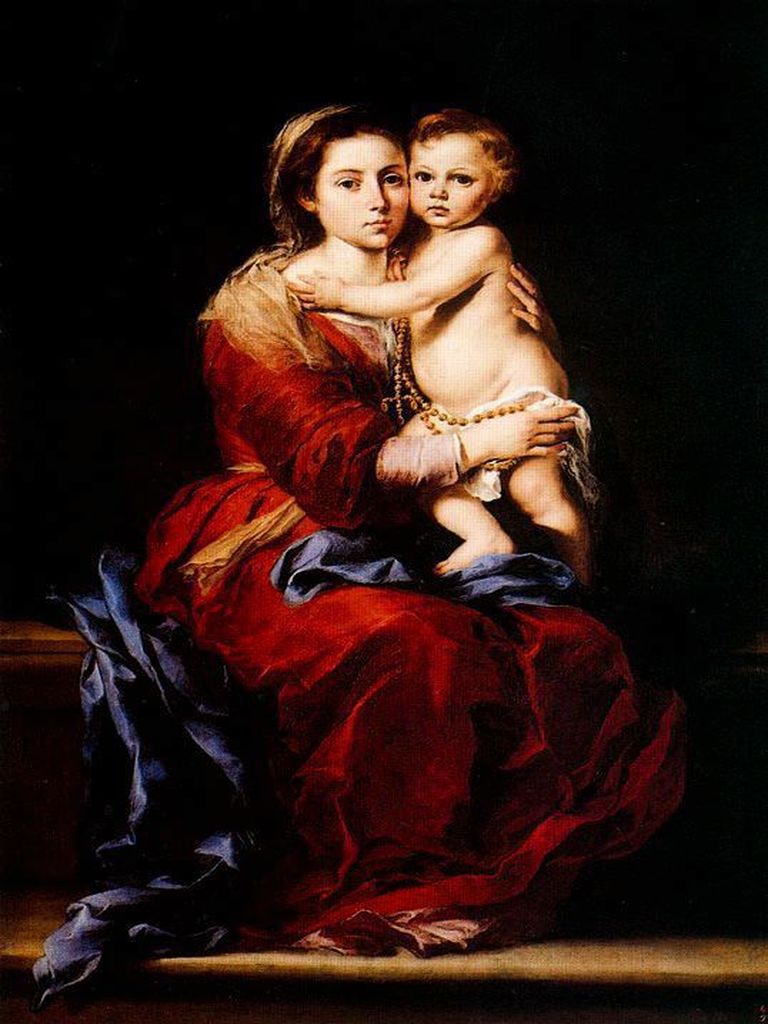
7 October Our Lady of the Rosary - We should meditate on the mysteries of salvation

The feast of the Holy Rosary was instituted by Pope Pius V to celebrate the anniversary of the defeat of the Turkish fleet at the battle of Lepanto on the first Sunday in October 1571, which ended the threat of Muslim domination of the Mediterranean and was ascribed in part to the prayers and processions of the Rosary confraternity in Rome. Later the feast was moved to the fixed date of 7 October.

A sermon by St Bernard

We should meditate on the mysteries of salvation

The child to be born of you will be called holy, the Son of God, the fountain of wisdom, the Word of the Father on high. Through you, blessed Virgin, this Word will become flesh, so that even though, as he says: I am in the Father and the Father is in me, it is still true for him to say: “I came forth from God and am here.”
  In the beginning was the Word. The spring was gushing forth, yet still within himself. Indeed, the Word was with God, truly dwelling in inaccessible light. And the Lord said from the beginning: I think thoughts of peace and not of affliction. Yet your thought was locked within you, and whatever you thought, we did not know; for who knew the mind of the Lord, or who was his counsellor?
  And so the idea of peace came down to do the work of peace: The Word was made flesh and even now dwells among us. It is by faith that he dwells in our hearts, in our memory, our intellect and penetrates even into our imagination. What concept could man have of God if he did not first fashion an image of him in his heart? By nature incomprehensible and inaccessible, he was invisible and unthinkable, but now he wished to be understood, to be seen and thought of.
  But how, you ask, was this done? He lay in a manger and rested on a virgin’s breast, preached on a mountain, and spent the night in prayer. He hung on a cross, grew pale in death, and roamed free among the dead and ruled over those in hell. He rose again on the third day, and showed the apostles the wounds of the nails, the signs of victory; and finally in their presence he ascended to the sanctuary of heaven.
  How can we not contemplate this story in truth, piety and holiness? Whatever of all this I consider, it is God I am considering; in all this he is my God. I have said it is wise to meditate on these truths, and I have thought it right to recall the abundant sweetness, given by the fruits of this priestly root; and Mary, drawing abundantly from heaven, has caused this sweetness to overflow for us.

7 oktober - Heilige maagd Maria van de Rozenkrans


Deze gedachtenis is door paus Pius V ingevoerd en gesteld op de verjaardag van de zeeslag bij Lepanto (7 oktober 1571), omdat deze overwinning werd toegeschreven aan de hulp van Maria, verkregen door het rozenkransgebed. De liturgische viering van deze dag vestigt onze aandacht op de overweging van de mysteries van Christus, waarin de maagd Maria ons is voorgegaan doordat zij op unieke wijze verbonden was met de menswording, het lijden en sterven, en de glorievolle verrijzenis van Gods Zoon.

God, door de boodschap van de engel hebt Gij ons geopenbaard dat uw Zoon is mens geworden. Wij vragen op voorspraak van de heilige maagd Maria, dat wij eens in heerlijkheid verrijzen omwille van het lijden en het kruis van Jezus onze Heer.

Our Lady of the Rosary little movie

woensdag 6 oktober 2021

7 oktober OLV Rozenkrans Wij moeten de heilsmysteries overwegen.

Deze gedachtenis is door paus Pius V ingevoerd en gesteld op de verjaardag van de zeeslag bij Lepanto (7 oktober 1571), omdat deze overwinning werd toegeschreven aan de hulp van Maria, verkregen door het rozenkransgebed. De liturgische viering van deze dag vestigt onze aandacht op de overweging van de mysteries van Christus, waarin de maagd Maria ons is voorgegaan doordat zij op unieke wijze verbonden was met de menswording, het lijden en sterven, en de glorievolle verrijzenis van Gods Zoon.

Uit een preek van de heilige Bernardus, abt van Clairvaux († 1153)

Wij moeten de heilsmysteries overwegen.

‘Wat uit u geboren wordt, zal heilig genoemd worden, Zoon van God’ (Lc. 1, 35). Bron van wijsheid, Woord van de Vader in den hoge! Dat Woord zal door uw bemiddeling, heilige Maagd, mens worden, zodat Hij die zegt: ‘Ik ben in de Vader en de Vader is in Mij’ (Joh. 14, 11), bovendien kan zeggen: van God ben Ik uitgegaan en gekomen.
‘In het begin - zo luidt het - was het Woord’ (Joh. 1, 1). De bron borrelt al op, maar vloeit intussen nog in zichzelf terug. Vervolgens: het Woord was bij God, want het woonde inderdaad in het ontoegankelijke licht. Eveneens vanaf den beginne sprak de Heer: ‘Mijn gedachten zijn gedachten van vrede en niet van onheil’ (Jer. 29, 11). Maar uw denken, Heer, blijft binnen U besloten; wat Gij denkt, weten wij niet. Want wie kende de gedachten van de Heer en wie was zijn raadsman? Daarom daalde uw gedachte van vrede af en ging over tot het werk van vrede: het Woord is vlees geworden en woont nu onder ons. Het woont inderdaad krachtens het geloof in ons hart, het woont in onze herinnering, het woont in ons denken, ja, het is zelfs afgedaald tot onze verbeelding, ons voorstellingsvermogen. Want wat voor denkbeeld kon de mens voordien maken van God, afgezien van de mogelijkheid in de geest een afgodsbeeld te maken? Onvatbaar was God en ontoegankelijk, onzichtbaar en geheel onvoorstelbaar. Voortaan echter wil Hij omvat worden, gezien worden; Hij wil het voorwerp worden van ons voorstellingsvermogen.
Gij vraagt: op welke wijze? Zoals Hij neerlag in de kribbe, zoals Hij rustte op de schoot van de Maagd, op de berg predikte, biddend de nacht doorbracht, zoals Hij aan het kruis hing, met de doodskleur getekend, zoals Hij onbelemmerd was onder de doden en in het dodenrijk heerste, zoals Hij op de derde dag verrees en aan de apostelen de littekens van de nagelen toonde als tekenen van zijn overwinning, zoals Hij tenslotte voor hun ogen opsteeg naar de hemel, die voor ons verborgen is.
Inderdaad, welke van deze gebeurtenissen wordt niet vroom, heilig en waarachtig overwogen? Telkens als ik hieraan denk, denk ik aan God, want in dit alles is Hijzelf mijn God. Dit overwegen noem ik wijsheid; de herinnering oproepen van de geur die hieruit opstijgt, noem ik inzicht. Het is de geur van vele bloeiende knoppen van de staf van Aäron, de zoete geur die Maria uit den hoge heeft ontvangen en overvloedig over ons heeft laten neerdalen.

zondag 6 oktober 2019

Cardinal Newman MEDITATION FOR THE FEAST OF THE HOLY ROSARY, 5 OCTOBER 1879

  Newman had no text for this short sermon. What we have here is the report given in a newspaper and written from notes taken at the time of preaching. It was delivered on Sunday, 5 October 1879. The Cardinal was then 78 years of age, and was speaking "from his heart" to the boys at Oscott College, in the north of Birmingham. As it was the Feast of the Holy Rosary, he preached on the text: "They found Mary and Joseph, and the Infant lying in a manger" (Lk 2,16). Five months previously, Newman was in Rome to be created Cardinal by Pope Leo XIII.

Personal love for the Rosary
Newman himself was very fond of his beads. He said: "to my own feelings nothing is more delightful" (The Letters and Diaries, XII, 217). For him it was not a matter of a mechanical repetition, but a meditation and contemplation of the mysteries of our Lord's life in the company of his Mother. He has not told us expressly how he said the Rosary, but the following advice which he gave to a recent convert whom he directed probably reflects Newman's own procedure: "Try it thus, if you don't so use it at present, but perhaps you do;—viz. before each mystery, set before you a picture of it, and fix your mind upon that picture (e.g. the Annunciation, the Agony, etc.) while you say the Pater and 10 Aves, not thinking of the words, only saying them correctly. Let the exercise be hardly more than a meditation. Perhaps this will overcome any sense of tedium" (The Letters and Diaries, XII, 263). Needless to say, the material repetition of Paters and Aves has then reached its scope and becomes genuine prayer (cf. Philip Boyce, OCD, 'At Prayer with Newman', in In Search of Light. Life Development Prayer. Three Essays on John Henry Newman. Rome, International Centre of Newman Friends, 1985, p. 82).
_________

I am not going to make a long address to you, my dear boys, or say anything that you have not often heard before from your superiors, for I know well in what good hands you are, and I know that their instructions come to you with greater force than any you can have from a stranger. If I speak to you at all, it is because I have lately come from the Holy Father, and am, in some sort, his representative, and so in the years to come you may remember that you saw me today and heard me speak in his name, and remember it to your profit.

You know that today we keep the Feast of the Holy Rosary, and I propose to say to you what occurs to me on this great subject. You know how that devotion came about; how, at a time when heresy was very widespread, and had called in the aid of sophistry, that can so powerfully aid infidelity against religion, God inspired St Dominic to institute and spread this devotion. It seems so simple and easy, but you know God chooses the small things of the world to humble the great (I Cor. 1,27-28).

Of course it was first of all for the poor and simple, but not for them only, for everyone who has practised the devotion knows that there is in it a soothing sweetness that there is in nothing else. It is difficult to know God by your own power, because He is incomprehensible. He is invisible to begin with, and therefore incomprehensible. We can in some way know Him, for even among the heathens there were some who had learned many truths about Him; but even they found it hard to conform their lives to their knowledge of Him. And so in His mercy He has given us a revelation of Himself by coming amongst us, to be one of ourselves, with all the relations and qualities of humanity, to gain us over. He came down from Heaven and dwelt amongst us, and died for us. All these things are in the Creed, which contains the chief things that He has revealed to us about Himself.

Now the great power of the Rosary lies in this, that it makes the Creed into a prayer; of course, the Creed is in some sense a prayer and a great act of homage to God; but the Rosary gives us the great truths of His life and death to meditate upon, and brings them nearer to our hearts. And so we contemplate all the great mysteries of His life and His birth in the manger; and so too the mysteries of His suffering and His glorified life. But even Christians, with all their knowledge of God, have usually more awe than love of Him, and the special virtue of the Rosary lies in the special way in which it looks at these mysteries; for with all our thoughts of Him are mingled thoughts of His Mother, and in the relations between Mother and Son we have set before us the Holy Family, the home in which God lived. Now the family is, even humanly considered, a sacred thing; how much more the family bound together by supernatural ties, and, above all, that in which God dwelt with His Blessed Mother.

This is what I should most wish you to remember in future years. For you will all of you have to go out into the world, and going out into the world means leaving home; and, my dear boys, you don't know what the world is now. You look forward to the time when you will go out into the world, and it seems to you very bright and full of promise. It is not wrong for you to look forward to that time; but most men who know the world find it a world of great trouble, and disappointments, and even misery. If it turns out so to you, seek a home in the Holy Family that you think about in the mysteries of the Rosary. Schoolboys know the difference between school and home. You often hear grown-up people say that the happiest time of their life was that passed at school but when they were at school you know they had a happier time, which was when they went home; that shows there is a good in home which cannot be found elsewhere. So that even if the world should actually prove to be all that you now fancy it, if it should bring you all that you could wish, yet you ought to have in the Holy Family a home with a holiness and sweetness about it that cannot be found elsewhere.

This is, my dear boys, what I most earnestly ask you. I ask you when you go out into the world, as you soon must, to make the Holy Family your home, to which you may turn from all the sorrow and care of the world and find a solace, a compensation, and a refuge. And this I say to you, not as if I should speak to you again, not as if I had of myself any claim upon you, but with the claims of the Holy Father, whose representative I am, and in the hope that in the days to come you will remember that I came amongst you and said it to you. And when I speak of the Holy Family I do not mean Our Lord and Our Lady only, but St Joseph too; for as we cannot separate Our Lord from His Mother, so we cannot separate St Joseph from them both; for who but he was their protector in all the scenes of Our Lord's early life? And with Joseph must be included St Elizabeth and St John, whom we naturally think of as part of the Holy Family; we read of them together and see them in pictures together. May you, my dear boys, throughout your life find a home in the Holy Family; the home of Our Lord and His Blessed Mother, St Joseph, St Elizabeth, and St John.

(Mary—The Virgin Mary in the Life and Writings of John Henry Newman, chap. 6, Edited by Philip Boyce).


Taken from:
L'Osservatore Romano
Weekly Edition in English
5 February 2003, page 10